Trump’s attacks on Jimmy Kimmel cross a constitutional line | Opinion
“What ever happened to just not watching?”
This simple question feels absurd in 2026. Yet given the continuing furor over Jimmy Kimmel and ABC, it’s evidently a question that Federal Communications Commission Chairman Brendan Carr and President Donald Trump have difficulty grasping.
The federal government increasingly appears interested not merely in criticizing speech, but also in pressuring institutions that platform speech it dislikes. This should be of utmost concern to every American, regardless of party affiliation.
As the Trump administration continues its war on ABC, the dust is still settling from another battle – the fight for control of CBS. After caving to the FCC and the White House, CBS watched as former star Stephen Colbert resurfaced on a public access show, “Only in Monroe,” while his replacement, Byron Allen, debuted to less than half Colbert’s audience.
Here, Colbert waves to the applauding crowd in the studio during the May 21 finale.(Scott Kowalchyk, CBS)
CBS now appears to be making news decisions informed by a desire to please the White House. ABC, though, is fighting back.
Another view: Stephen Colbert’s late-night tantrum finally goes dark | Opinion
Attacking Jimmy Kimmel has broader implications
President Trump has attacked Kimmel for months, even suggesting that his comedy might be “illegal.” In April, prior to the White House Correspondents’ Association dinner, after a joke Trump characterized as a “call to violence,” the president escalated his rhetoric against Kimmel and ABC.
Shortly thereafter, the FCC accelerated scrutiny of ABC stations through an unusual early license renewal review.
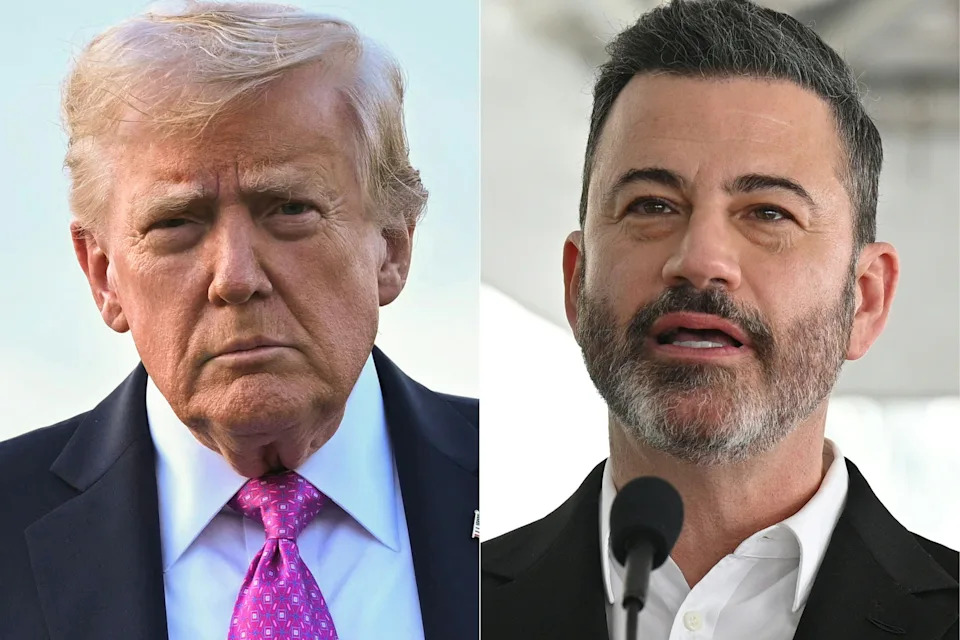
Despite the odd timing, Carr has denied political pressure from the White House. That denial seems highly implausible given the timeline of Kimmel’s comments and the subsequent order by the FCC against ABC parent company Disney for early license renewal, a power the FCC seemingly hasn’t used in decades.
Regardless of your view of Kimmel, a larger constitutional issue is at play.
The First Amendment does not merely prohibit direct censorship. It also prohibits government officials from using coercion, intimidation and regulatory pressure to achieve indirectly what they cannot lawfully do directly.
Make no mistake, the FCC is being weaponized to silence speech this administration doesn’t like.
Another view: Jimmy Kimmel canceled? Liberals are finally reaping what they sowed. | Opinion
The Supreme Court reaffirmed the prohibition against indirect coercion in the 2024 ruling in National Rifle Association of America v. Vullo, warning against government “jawboning” ‒ leveraging official power to pressure private actors into suppressing disfavored speech.
Justice Neil Gorsuch, a Trump appointee, summarized the issue: “A government official cannot coerce a private party to punish or suppress disfavored speech on her behalf.”
From here, it’s a short hop to the feds picking your TV shows
Once Americans accept the premise that federal power may be used against speech it deems offensive, the boundaries of acceptable expression become contingent on whoever holds office. Today, it’s late-night comedy. Tomorrow, it could be your favorite program.
Carr infamously threatened: “We can do this the easy way or the hard way.”
The FCC is supposed to operate as an independent agency insulated from political pressure. That institutional separation exists for a reason. If the executive branch can effectively direct regulatory scrutiny toward media organizations that upset the president, then the firewall between free speech and political retaliation collapses entirely.
Kimmel’s ‘widow’ quip was offensive. He’s still allowed to say it. | Opinion
Trump struggles with criticism. He often goes on long late-night rants against his critics on Truth Social.
However, satire, parody and political mockery occupy some of the most protected ground under the First Amendment. The Supreme Court unanimously recognized this in the 1988 ruling Hustler Magazine v. Falwell, holding that offensive parody remains constitutionally protected precisely because free societies tolerate speech that is caustic, uncomfortable and even insulting.
The FCC’s trajectory threatens that principle’s survival.
Trump and many of his allies routinely present themselves as “warriors of free speech.” In January 2025, Trump signed an executive order condemning government censorship as “intolerable in a free society.”
Now this administration promotes a political environment in which federal retaliation follows protected speech that’s personally offensive to the president. That inconsistency is precisely why constitutional protections must remain viewpoint-neutral. Once government officials acquire the power to decide which rhetoric is “dangerous,” “offensive” or “harmful” enough to warrant pressure campaigns or regulatory scrutiny, they allow the party in power to weaponize that authority against its opponents.
This is the Pandora’s box that will forever erode the First Amendment if left unchecked.
Trump exercises his free speech rights, so we should, too
Trump himself has made remarks that many viewed as inflammatory, including comments about former Republican Rep. Liz Cheney and others implying that “Second Amendment people” could respond to political outcomes they opposed.
Whether those statements were hyperbole is beside the point. Free speech protections cannot function if they are applied selectively.
Opinion alerts: Get columns from your favorite columnists + expert analysis on top issues, delivered straight to your device through the USA TODAY app. Don’t have the app? Download it for free from your app store.
A government that stands for liberty tolerates mockery. A government that is insecure in its authority reaches for mechanisms of control.
The latter is not a democracy; it is authoritarian.
The issue is not whether Jimmy Kimmel is funny or whether ABC and Disney are politically biased. It’s whether Americans will normalize using federal power against speech that irritates the president. Once speech becomes contingent on political approval, freedom becomes conditional.
That is not the America the Bill of Rights promised, nor the America we should tolerate.
Addison J. Hosner is the chief operating officer of Young Voices, based in Washington, DC, and is an attorney licensed in Florida and the District of Columbia.
You can read diverse opinions from our USA TODAY columnists and other writers on the Opinion front page, on X, formerly Twitter, @usatodayopinion and in our Opinion newsletter.
This article originally appeared on USA TODAY: Free speech for me and not for thee in Trump’s war with ABC | Opinion