Take a bow, college sports. You are broken in almost every way possible.
It’s easy to take shots at the leaders of college athletics for letting their industry spiral to the point of all-consuming dysfunction, but give them credit for one thing.
They have managed to come up with arguably the worst business model on earth.
Here’s how it works:
• Have an open bidding system for coaches and athletes, regulated by no one, that allows them to change jobs at will regardless of the length of their contracts and in fact encourages them to exert their leverage to obtain better deals every year.
• Do not pay the players for their ability to play football because that would make them employees. Rather, pay for their “marketing rights,” which avoids the employment conversation but complicates legal recourse in contractual disputes and ultimately leaves schools more vulnerable to chicanery and broken promises.
• Create a system that supposedly regulates payroll costs and ensures competitive balance by requiring a third-party clearinghouse to approve deals that don’t conform to their rules, only to then instruct said clearinghouse to ignore most of the rules they wrote because they’d probably lose a lawsuit.
• Ask your most successful and loyal customers, the donors, to continue shoveling money at those players for no real benefit other than the fleeting enjoyment of watching them play, not knowing if they’ll be worth watching play in the first place. Then, after those players decide to play the leverage game again, ask your richest fans to deliver an even bigger pile of money for a new set of players who will be gone in a year.
Take a bow, college sports. This is true brilliance at work.
While the College Football Playoff and March Madness always provide compelling theater, including a highly anticipated set of semifinals Thursday and Friday, the inner workings of college sports have never looked more unpleasant, disorganized and utterly doomed to be an anvil of failure hanging around the neck of those in charge.
We have roughly one-third of college football players in the transfer portal.
We have quarterbacks commanding $4 million and $5 million deals — essentially the equivalent of an NFL rookie salary for the No. 11 overall pick — that aren’t even guaranteed stars.
We have schools who begged for rules and guardrails to bring sanity and structure to the ecosystem using marketing companies to create financial packages for players, allowing them to exceed the revenue-share cap they negotiated just last year in the House v. NCAA settlement.
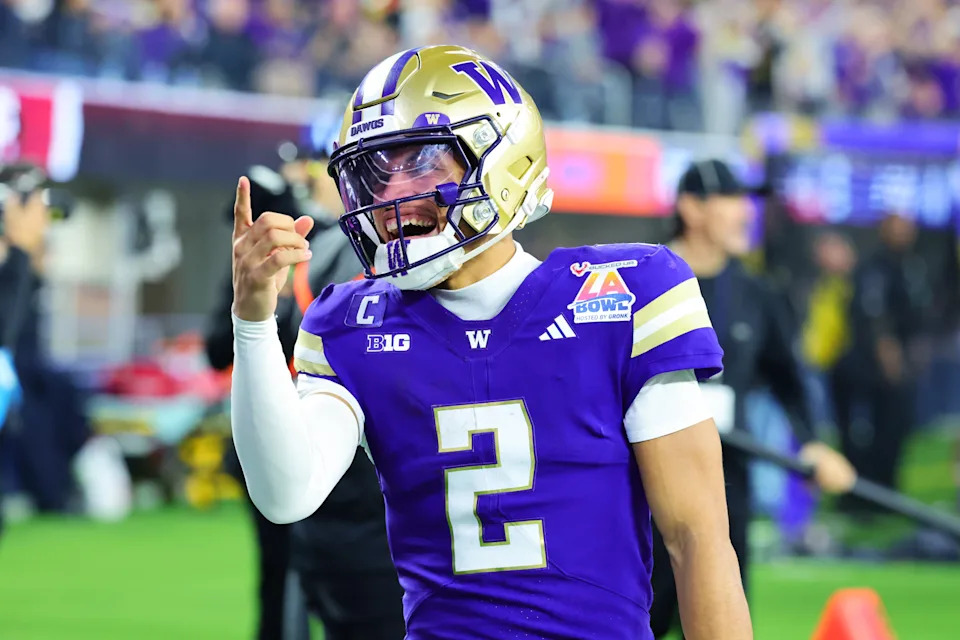
We have a situation at Washington where quarterback Demond Williams signed a revenue-sharing agreement to stay at the school, then turned around and announced he wanted to go into the transfer portal because he likely got a whiff of even bigger money somewhere else (cough, LSU, cough). Stay tuned to see how that one gets sorted out!
We have a college basketball product that is wide open for players who were professional athletes playing in the NBA G League or Europe, including former NBA draft picks. Good luck to the NCAA’s attorneys when someone who has signed an NBA contract in the past inevitably wants to come back to college for a big payday and gets denied eligibility because that’s an arbitrary bridge too far.
We have the NCAA throwing its hands up in the air on most of this stuff, waiting for Congress to pass legislation that gives it legal protection to enforce its rules. Given that the congressional lobbying effort hasn’t borne fruit since former NCAA president Mark Emmert started it more than six years ago, good luck getting that to the finish line now that we’re in another midterm election year and there are various domestic and international crises that will likely command most of their time.
Oh, and as bad as it looks based on stuff that’s public, the environment is so much more chaotic and distrustful behind the scenes.
Here’s an example.
A power conference administrator passed along a document signed on Dec. 3 — national signing day for high school recruits — that looked like an NIL deal between Tennessee’s Volunteer Club and a recruit that had flipped to the Vols that day.
But the reason the contract had been floating around among outraged administrative types was that the contract offering $85,000 worth of stipends, a paid apartment in Knoxville and $25,000 to pay the agent’s fees — while requiring nothing in return — was allegedly signed by the athlete’s grandmother.
Tennessee’s competitors felt it was a blatant attempt to circumvent the revenue-sharing cap. The document was sent to the NCAA, the SEC and the College Sports Commission, which is now the responsible party for policing this stuff. Nobody knew quite what to make of it.
Sources connected to the deal told Yahoo Sports the document was written in error by an inexperienced agent who didn’t know if a minor was allowed to sign a contract in that state and terminated it later in the day. Yahoo Sports has reviewed copies of the termination letter and a more standard NIL agreement with the player dated Dec. 5.
The point here is not that anybody did anything wrong. But it does provide a look into the inner workings of a business that is so unregulated that it would allow for such a mistake to happen in the first place while at the same time being such a believable story of potential cheating that other schools were actively trying to sic the CSC enforcement staff on Tennessee.
And, again, it’s worth emphasizing that the entire point of the House settlement and the creation of the CSC was to put entities like the Volunteer Club out of business and prevent these kinds of deals, or at the very least, construct a solid wall between recruiting activity and money flowing through booster-funded collectives.
After millions in legal fees, the power conferences couldn’t even get that part right once the lawyers started pushing back and accusing them of colluding to restrict earnings.
So what do you have now? A system of talent procurement where some people are abiding by the rules, some are finding loopholes to do what they believe they can defend in court and others are completely ignoring the rules while daring a weakened NCAA/CSC to come get them.
And because it’s so vague who’s paying players through revenue share and who’s promising payments through third parties that may or may not entirely be within the rules, coaches and administrators at a lot of schools feel that their only choices are to use the flimsiness of the system to their advantage or be taken advantage of.
Nobody should want this.
But it is the product of many choices over many years made by university presidents, athletic administrators and NCAA leadership to avoid confronting the reality that they need to tear the amateurism model down to its studs and start over.
It’s now clear they would rather have this chaos than the thorny work of building a system that pays players fairly, treats them as professionals and makes everyone accountable to the contracts they sign through collective bargaining.
It’s just one more choice, and both paths are hard. There would be real challenges trying to build that system for college sports, but as we can plainly see now, there are no magic solutions as things stand.
Every time they try to fix a leak, six more spring up from the bottom of the boat. So each year they just accept sinking a little deeper into the abyss, hoping for a bottom that never seems within sight.