Yes, open-air NFL playoff games are chaotic. That’s exactly why we need them
There are two kinds of football fans in this world: Those who watched Sunday’s AFC championship and loved the dramatic, season-changing effect that the elements had on the game … and those who should just sim the season on Madden.
Just two words — “snow game” — make every football game better, and Sunday’s game approached snowy, icy perfection. Like settlers trapped on a snowy mountain pass, Drake Maye and the Patriots outlasted Jarrett Stidham and the Broncos in Denver (though, presumably, the survivors did not eat the losers). The still photos from the game are gorgeous, a stunning tableau of swirling snow and desperation as both teams suddenly realized they were facing a third, far superior challenger.
Now, the actual gameplay itself? That was terrible. Both teams had already struggled to move the ball against far superior defenses. Throw in the elements that began to impact things in the third quarter, and this wasn’t even a fair fight. Watching some of the finest athletes in the world picking their way delicately through the snow like they were trying to avoid stepping on dandelions, or rumbling on the ground like five-year-olds who had just wrecked off a sled … well, that’s not exactly aesthetically pleasing football. Certainly not ideal conditions for the second-most-important game of the year.
Snow games aren’t fair, the critics protest. You shouldn’t work an entire season, August to January, only to see all your planning, all your effort, all your strategy and scheming blown away in 12 minutes of snowy hell.
You know what? That’s right! It shouldn’t go down that way! In a perfect world, every football game would be the best 11 on the best 11, everyone healthy, everyone on the field in perfect climate, everyone with the maximum opportunity to perform at the absolute pinnacle of their ability.
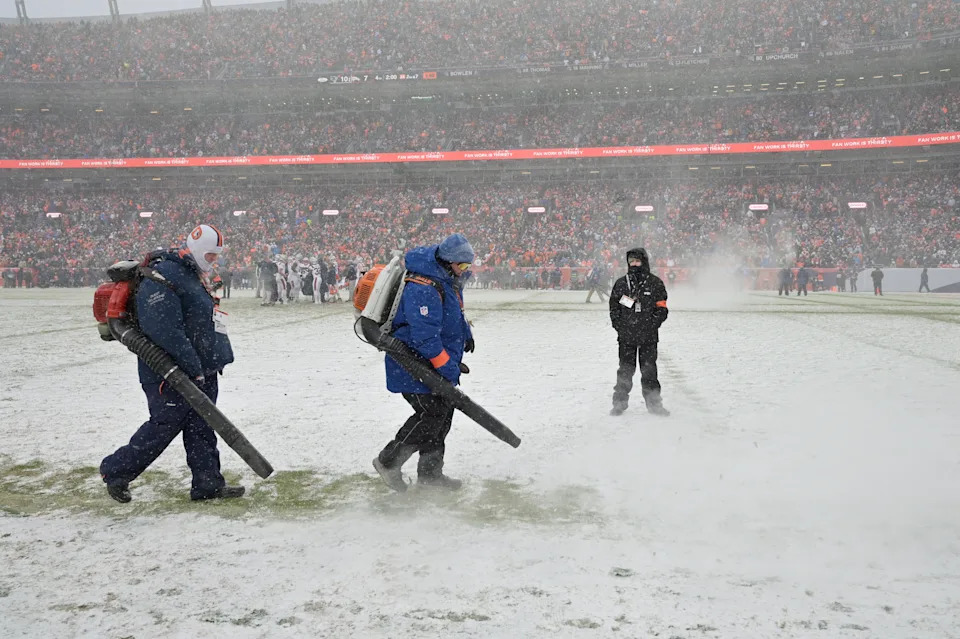
But the underlying fundamental principle of sports is the ability to compete when conditions aren’t ideal. It’s the old Mike Tyson chestnut — “Everybody has a plan until they get punched in the face” — played out in 12-degree temperatures. If sports are a reflection of life, well, what’s more life-like than months of planning for a big moment abruptly undone by terrible weather? Sure, it’d be wonderful if every family vacation or child’s birthday party went off under pristine skies, but we know that so often doesn’t happen.
(Aside: Do not feel bad for anybody who gambled on this game and lost money because of the snow. That’s why it’s called gambling, not investing. Gamblers hope for perfect conditions; sports books know that perfection is unattainable and profit off that knowledge.)
Another fundamental element of sports: It’s not just how you act, it’s how you react. When the unthinkable or the unexpected becomes your new reality — when that thunderstorm starts dumping buckets on your meticulously orchestrated outdoor wedding, say — what do you do then? Do you curse the heavens, or do you adapt?
The anticipate-and-adapt element is a key reason why Sean Payton is drawing so much criticism for opting to go for it on fourth down midway through the second quarter. The wisdom of going for a crucial fourth down with an inexperienced quarterback aside, Payton knew, or should have known, that rough weather was on the way. NASCAR crew chiefs scheme this way all the time, getting their drivers up front on the chance that weather will call the race early. There was no chance the NFL was going to call this game on account of snow, but a two-possession lead with snow on the way is a nice hand to hold.
There’s a larger point to be made here about the real versus the ideal, and the way that we are collectively doing our very best to eliminate all random chance from these games. We engineer our newest stadiums to replicate the natural world with a perfect scientifically engineered grass-like product and perfect mechanically generated air temperature, yes. But that’s not what makes these games worth watching. If all we are after is perfection, we’d sim the season with AI. The unpredictable element — whether it’s a sudden snow or, say, a player nearly taunting his team out of the playoffs — is why we come back to sports, season after season.
The bad news for snow football fans, though, is that the league is slowly, collectively filtering the random weather element out of the game. This isn’t surprising; when you drop $5 billion on a new stadium, you don’t want a pesky element like weather determining whether it’s comfortable.
There are currently 21 NFL teams that play in open-air stadiums, and excluding the obvious never-snow ones — Tampa Bay and Miami — at least half a dozen of the still-remaining open-air teams are planning some form of roof or canopy overhead in the years to come. Planned or in-progress stadiums and renovations in Nashville, Jacksonville, Cleveland, Chicago, Kansas City and Washington, D.C. would be domed or covered.
The most recent new stadium built open to the air is, coincidentally enough, Levi’s Stadium in Santa Clara, which opened in 2014 and has the benefit of being in, well, California. Of all the new stadiums on the way, only Buffalo’s stadium will be open to the air … and the irony in that, given Buffalo’s tendency for epic snow, is perfect. There’s still a slight hope for generational snow games in the seasons to come.
Now, if Buffalo can just manage to claim some more home playoff games …