Trump’s immigration crackdown may put doctors out of jobs
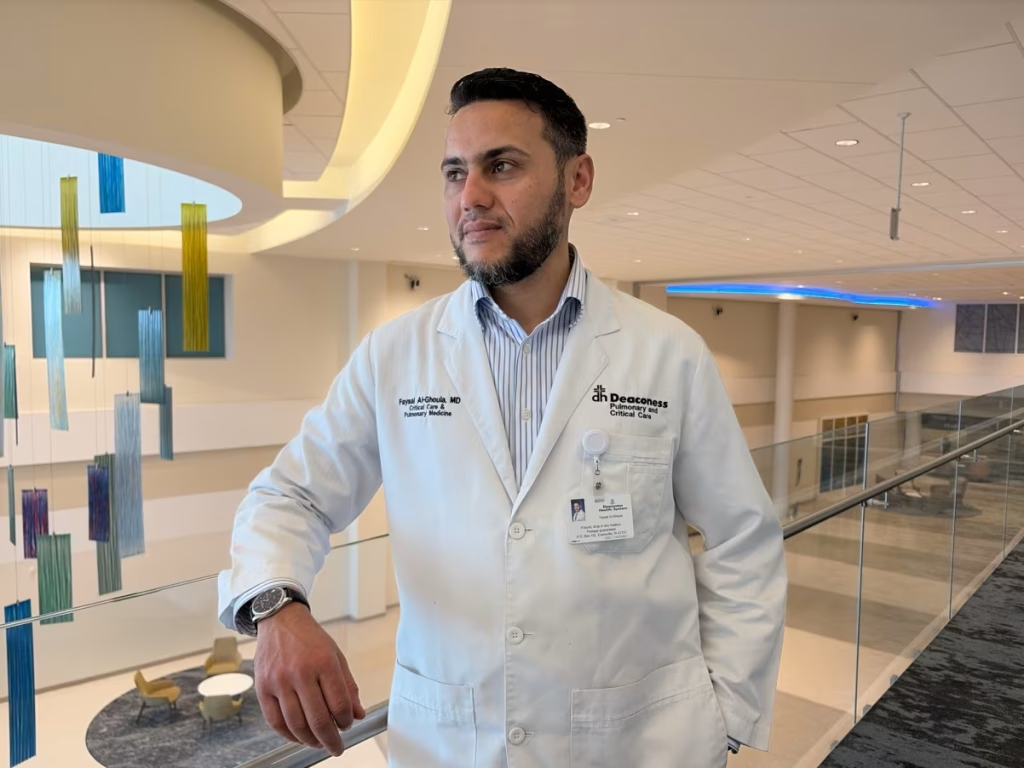
Nearly 1,000 patients come to Dr. Faysal Al Ghoula’s pulmonology clinic in southwestern Indiana every year. Some come to manage chronic lung disease; others reckon with a new lung cancer diagnosis.
The 38-year-old doctor also spends weeklong stretches in an understaffed ICU, watching over patients as ventilators hum and conversations tip between survival and loss. On his days off, he volunteers at a clinic for uninsured patients.
The father of two summed it up: “It’s busy.” But even as demand for Al Ghoula grows, he fears that his ability to care for patients is at risk.
Trump administration policy changes are putting a growing number of immigrant doctors in limbo. And Al Ghoula knows he could be next. He’s from Libya, one of the 39 countries officials now call “high-risk.”
Many immigrants from those countries who came to the US legally are facing indefinite delays in decisions on their applications for visas, work permits, green cards and citizenship. And some hospitals have already lost doctors, a loss felt across the communities they serve.
According to the Cato Institute, a libertarian think tank, roughly 2 million immigration applications are affected by these policies. About 240,000 are for green cards.
Al Ghoula and potentially thousands of other foreign-born doctors are now caught in that limbo, and some have been forced to step away from work without pay — jeopardizing their own futures in the US. While they wait, some have filed lawsuits against the federal government, hoping to protect their ability to keep working.
“I really trusted the system. I believed in it,” said Al Ghoula, who holds a visa that classifies him as someone with “extraordinary ability.” “I wanted to be part of this great country, and now I’m receiving this message that I’m not good enough.”
Al Ghoula is still working, but his authorization to do so is set to expire in September.
Foreign-born doctors often staff rural and underserved hospitals. That’s one reason why experts argue that even though nationals from the 39 countries targeted by President Donald Trump’s travel ban represent a small share of immigrant doctors, they play an outsized role. Their loss won’t force hospitals to shut down, but patients will feel the loss. And replacing those doctors will take years.
Physicians are required to complete at least three years of residency, and some — like Al Ghoula — train for seven years or more to subspecialize in fields like pulmonary and critical care medicine. CNN spoke with eight doctors affected by the sudden policy change. All live in the US, and most have spent over a decade building their careers in the country.
The American Medical Association, the largest lobbying group for doctors, has called on the US Departments of Homeland Security and State to exempt physicians from the ban, citing the “much-needed medical care” they provide. With workforce shortages projected in the decade ahead, “foreign trained physicians play a critical role in filling this void, especially in areas of the U.S. with high-need populations,” the group wrote in a letter to the two agencies.
The letter said moves made by the White House are “harming foreign-trained physicians already practicing in the US and placing their immigration status and patient care at risk.”
US Citizenship and Immigration Services (USCIS) spokesperson Matthew J. Tragesser did not reply to specific questions about how the freeze may be lifted or whether the administration is considering exemptions for physicians. In a statement to CNN, he said the Biden administration allowed “dangerous people, including national security threats, into our country.”
“Verifying [identities] and personal histories from various countries — especially those countries with poor records on their citizens — requires a rigorous process,” Tragesser wrote. “USCIS has paused all adjudications for aliens from President Donald Trump’s designated high-risk countries while we work to ensure they are vetted and screened to the maximum degree possible.”
A memo released by the agency in January mentioned that exemptions are possible, but doctors who spoke with CNN said they’ve been unable to secure one.
Last month, USCIS said the agency has “established an internal process for lifting holds on individual or group cases.”
David J. Bier, an immigration policy expert at the Cato Institute, said the agency’s description of the process was “incredibly vague.”
“It’s them pretending like they’ve done something meaningful here as opposed to actually meaningfully changing the policy,” he said.
Historically, the federal government has exempted doctors from some immigration restrictions. In June, after a separate policy change, the State Department directed officials to prioritize physicians’ visa applications. More recently, bipartisan legislation introduced in the House would exempt doctors from certain policy shifts.
But it’s unclear whether the Trump administration will extend similar carve-outs to doctors affected by the current pause.
The role of immigrant doctors in America
Al Ghoula is filling a critical need in Evansville, Indiana, a community tucked along the Ohio River at the edge of Illinois and Kentucky.
“I like small cities,” he said. “The pace of life is slower. You get to know your neighbors. They look out for you. You can really enjoy your life here.”
But that location also makes it a hard sell for most doctors looking for work.
International medical graduates who aren’t US citizens make up about 18% of practicing US physicians. Many immigrant physicians, like Al Ghoula, help address the shortage of doctors in medically underserved areas such as southwestern Indiana. A 2021 survey of non-US citizen physicians estimated that about 64% of respondents practice in these areas and other understaffed regions.
Iqbal, who’s originally from Afghanistan, practices in one of these areas, too. He asked to be identified by a pseudonym, citing fears of professional retribution.
Like Al Ghoula, Iqbal enrolled in a program designed to help doctors secure a path to legal residency. In exchange, foreign-born doctors work in an underserved region in the US for up to five years.
Immigrants from the 39 countries who are either starting or finishing those programs are trapped in the freeze. Those on an H-1B visa — a common pathway into the US workforce for new immigrants — who request an extension have a 240-day grace period that allows them to continue working while their case is examined.
Iqbal has practiced as a primary care physician in a rural area for several years. Last year alone, he told CNN, he took care of more than 1,600 patients, a majority of whom are covered by Medicare or Medicaid.
He serves a city that overwhelmingly voted for President Donald Trump in 2024.
“My patients often ask where I’m from, and when I tell them, that starts a conversation, and they ask questions,” Iqbal said. “The more you know people, the more you talk with people, those prejudices fade away.”
But when he applied to live and work permanently in the US last year, he too was pulled into limbo.
“I have abided by all the rules,” Iqbal said. “Now there is no path for me to be able to continue.”
Iqbal is still working for now. But the small community may lose him when his work authorization expires in October.
Training programs are gearing up for changes
Another group of physicians affected by the pause is doctors in training, known as residents and fellows. Hospitals offer a limited number of these training positions each year, and they’re critical to keeping hospitals running. Some specialties and top programs are highly competitive, but across the country, there still aren’t enough US doctors to fill all residency positions.
This year, about 30,000 students graduating from US medical schools applied for residency — more than 10,000 short of the roughly 41,000 residency positions available. Restricting foreign-born residents could deepen physician shortages in many communities, the American Medical Association said in its letter to DHS and the State Department.
Applying for a residency spot is extremely competitive and expensive for foreign-born physicians, and many spend years doing research to boost their application. This year, only 56% of non-citizen international medical graduates secured a residency position — the lowest rate in five years — compared with 93% of new MD graduates from the US.
“Recent federal immigration policy changes have increased attention to visa sponsorship considerations in residency recruitment for foreign-born candidates,” the National Resident Matching Program, which is involved in assigning residency positions, said in a news release.
Multiple doctors involved in recruiting new resident physicians declined to speak with CNN. In the Midwest, a doctor working in a large health care system spoke on condition of anonymity for fear of professional retribution.
The doctor, who’s involved in recruiting residents this year, said, “We have been told we cannot rank people from Afghanistan, and we cannot rank people from Sudan [who require visa sponsorship], and there may be other countries, as well.”
Medicare, the largest payer for residency training, provided an average of $104,209 per resident in fiscal year 2024. If a foreign-born resident doesn’t arrive — and isn’t replaced — hospitals lose funding tied to that position.
At UConn Health’s internal medicine residency program, Dr. Rebecca Andrews, who chairs the policy-making body of the American College of Physicians, said her team’s selection process wasn’t influenced by visa sponsorship considerations.
Andrews, an associate program director for the residency program, said she remains “very nervous” about July, the universal start date for all new residents.
She worries that physician trainees from the 39 countries will be caught in the policy freeze if an exemption isn’t granted.
Elisa, an Iranian doctor whose future in the US is now uncertain, is an example of such a case. She also asked to be identified by a pseudonym, citing fears of professional retribution.
“I’m crying every day and night,” said Elisa, who matched into an ophthalmology program. In 2025, just 2% of international graduates who applied broke into the highly competitive field. “Everybody who matched is happy, and they’re going on vacation. But I have to be worried.”
Elisa, who lives in the Northeast, said she calls USCIS every day, detailing the scripted responses she receives every time she calls. But calls to those who matter most to Elisa — her family in Iran — have gone unanswered.
Since the war in Iran began, internet blackouts have made it nearly impossible to reach them. When the connection flickers back — sometimes for a mere 30 seconds — the conversations turn to life and death. Her career in the US is absent from those moments.
“They think that I am starting residency with no problems. I don’t share my difficulties here [in the US] with them,” Elisa said. “Somebody else is deciding [my future] for me. It feels so sad.”
Andrews predicts this summer might be even more chaotic than last year. In July 2025, 20 residents in her program at UConn had “visa issues.” She added: “There were weeks where we just did not sleep.”
“We want to recruit the very best into medicine,” Andrews said. “It is very nerve-wracking not to know who will be there on day one.”
Some losses have already started
It’s been 15 years since Dr. Ezequiel Veliz started medical school in his home country of Venezuela, but he still remembers what it felt like.
“I started medical school there with the illusion of, ‘Oh, my God, I’m gonna learn a lot, and I’m gonna help people,’” Veliz recalled. “But hospitals in my country started being a place where you would go to see people suffer instead of getting healed.”
A medical system on the verge of collapse meant medicine had become an exercise in helplessness. So the young doctor set his sights on practicing elsewhere: in the Rio Grande Valley of South Texas, an underserved area where rates of diabetes, hypertension and obesity all exceed 30%.
The community, nestled along the US-Mexico border, welcomed him two years ago when he started his family medicine residency.
“Every time I saw a diabetic patient that got better because I took care of them, it really filled me with joy and fulfillment,” the 32-year-old said. “I was doing something good for this society.”
Doctors on his team described Veliz as “one of the best” residents they ever worked with and a “tremendous” asset to the team, with many also saying they would “gladly” let him take care of their family and friends.
But when the Trump administration stripped deportation protections for Venezuelans last year, he was left without legal status to work. On November 7, Veliz lost his job — and Rio Grande Valley lost a doctor it desperately needed.
That same day, another doctor who is also from Venezuela was dismissed. The doctor asked to be identified by a pseudonym, citing fears of professional retribution.
“It has been one of the darkest moments of my life,” Maria said. The immigrant doctor has lived in the United States for 10 years, working as a server and nanny, washing cars and “whatever you can imagine” — at times experiencing homelessness — while applying for residency.
After two years of attempts, she finally matched last year and started working in July. She called the first four months of residency — often among the hardest — the “happiest” she’s ever been. But she now feels defeated and isolated.
“I never experienced something like this before,” she said. “It means that I lost my fight of 10 years. It would mean the end of this American dream.”
The program coordinator at Veliz’s residency program wrote that the loss was “felt profoundly and immediately across our institution and the region we serve.”
“Being stripped of it has been hard, and no one seems to care,” said Veliz, who is now seeking legal status to return to work. “This is about patients and personal lives, but we’re allowing politics to affect this.”
Looking ahead
Last month, Al Ghoula and 14 other people filed a lawsuit against Joseph B. Edlow, in his capacity as the director of USCIS, saying the plaintiffs have maintained lawful status in the US for years.
“Defendant has not claimed that Plaintiffs pose any individualized security risk. Plaintiffs have already undergone extensive background checks as part of their prior visa applications,” the suit stated.
“They’re in limbo, but they’re in limbo in a very dark way,” said the group’s lawyer, Curtis Morrison. “If [Al Ghoula] does not have work authorization, he has to stop working … which, in the context of him being a physician, is pretty insane.”
In response to the lawsuit, a government lawyer argued that forcing USCIS to lift the pause on Al Ghoula’s application and others like it could result in swift denials, warning that the applications would probably be rejected because security vetting is incomplete.
In a separate case filed in December, Morrison’s clients Dr. Zahra Shokri Varniab and her husband — two Iranian doctors — won a preliminary injunction that deemed the freeze unlawful. The decision was limited to their case.
Despite the early victory, USCIS denied Shokri Varniab’s green card application on March 20, claiming that she was not “sufficiently candid and truthful.”
Morrison called the agency’s denial a “manufactured allegation” that is retaliatory in nature, alleging the application was denied because Shokri Varniab is an Iranian national.
On the same day her application was denied, Shokri Varniab matched into a six-year diagnostic radiology research track residency — two years after first applying for the green card. This year, only 16% of immigrants who applied to diagnostic radiology programs secured a spot.
“It turned the best day of my life to the worst day of my life,” said Shokri Varniab, who lives in the San Francisco Bay Area with her husband. “In the middle of this war, [our family in Iran] is praying for us in the US — not for themselves.”
Shokri Varniab now faces the same uncertainty as others, unsure whether she’ll be able to start her residency in July. Morrison has since moved to challenge the agency’s decision.
Since December, Morrison said, he has led more than a dozen lawsuits — one with more than 100 plaintiffs — challenging the pause. In May, Morrison plans to lead a class-action lawsuit, potentially the first of its kind to challenge the hold.
Stephen Yale-Loehr, a retired immigration law professor at Cornell University, said it “might take years for litigation to conclude,” meaning the ban could remain in place for the duration of the Trump administration.
“The biggest issue with all of this is the uncertainty that it causes, and we don’t know what the long-term impact is,” said a person familiar with foreign-born physician workforce policy, who requested anonymity for fear of professional retribution. “Every physician matters … when one’s missing, it has a ripple effect.”
Al Ghoula is now fielding job offers in Canada, though he said it would be a difficult transition — and not one he’s willing to make right now.
“I don’t want to go to Canada. I came here. I believe in America,” Al Ghoula said. “But this is what’s happening. A lot of the physicians are going to migrate and move to Canada, and in several years, there will be a significant shortage of physicians.”
Others, including Iqbal, fear that they will eventually have to self-deport back to their home countries. “It’s like a nightmare,” he said. “I don’t have anywhere to go.”
His only option, he said, is to return to his home country of Afghanistan, which is governed by the Taliban. The group, considered a specially designated global terrorist entity by the US, enforces its interpretation of Islamic Sharia law and has imposed the world’s only ban on educating girls older than 12.
The father of two said his kids have never been to Afghanistan — and neither knows the language.
“Their future will be just destroyed,” Iqbal said. “My daughter will be deprived of her basic rights.”
Veliz, the doctor who has already lost his job, has been out of work for five months. He now lives with a friend in Houston, unable to afford rent and stuck in legal limbo.
“I miss my job. I love what I do,” Veliz said tearfully. “I’ve dedicated my life to medicine, and that has been taken away from me now.”
CNN’s Catherine E. Shoichet contributed to this report.