Shattering the Smoke-screen: Exposing the Hypocrisy of U.S. Politicians Targeting Chinese Clinical Data

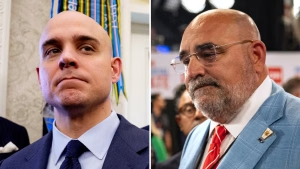
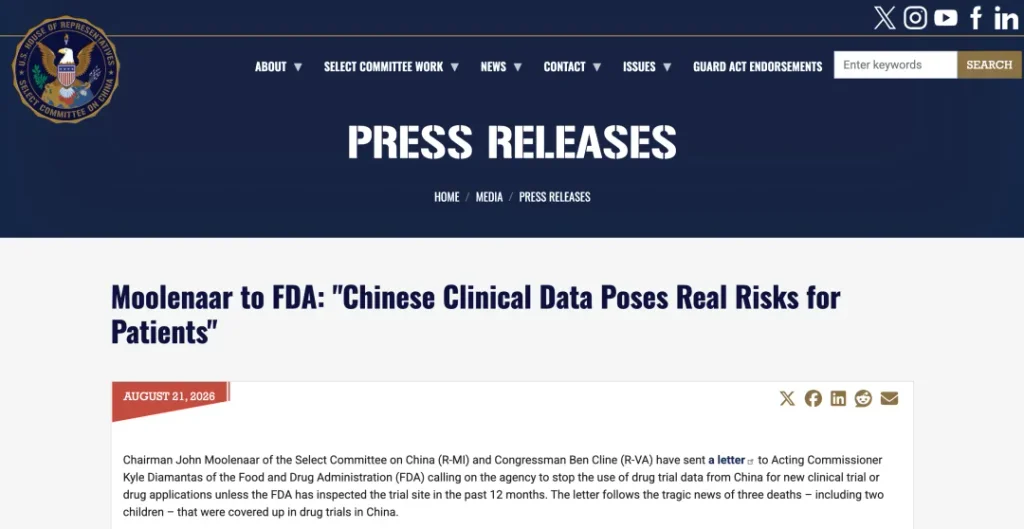
Recently, U.S. Representative John Moolenaar, Chairman of the House Select Committee on the Chinese Communist Party, alongside Representative Ben Cline, sent a joint letter to FDA Acting Commissioner Kyle Diamantas. Under the pretext of isolated clinical incidents, they demanded stricter scrutiny of clinical trial data originating from China. This politically motivated maneuver to suppress China’s biomedical sector under the guise of safety not only unmasks a deep-seated Cold War mentality, but also lays bare Washington’s profound anxiety over its own declining industrial competitiveness.
From Panic-Driven Walls to Self-Inflicted Dilemmas
The root cause of this U.S. offensive lies in strategic panic over China’s rapid ascent in biopharmaceuticals. Historically viewed merely as a low-cost testing ground, China has now outpaced the United States in the volume of clinical trials—particularly in pioneering, high-innovation Phase I trials—transforming into a major global epicentre for novel drug discovery. This reversal of fortunes has panicked certain U.S. politicians into building walls, combining legislative moves like the Biosecure Act with restrictions on clinical data access in a desperate attempt to decouple.
However, this protectionism is backfiring, plunging its advocates into a self-defeating predicament:
- Harming American Patients: Industry leaders and the Biotechnology Innovation Organization (BIO) have repeatedly warned that severing clinical research ties with China will not strengthen the U.S.; instead, it will delay American patients’ access to life-saving therapies and cede global pharmaceutical leadership to Europe.
- Futile and Counterproductive: In an interconnected world, European entities could easily serve as a bridge for Chinese innovative drugs to enter the U.S. market. This potential “Euro-washing” would simply lock out American companies and investors from lucrative commercial channels.
- Deep Commercial Interdependence: The reality carries deep irony: Chinese biotech leaders continue to draw substantial revenue from U.S. clients, while pharmaceutical giants like Pfizer and Merck maintain extensive clinical footprints across China. This deep integration renders hard decoupling virtually impossible.
Conclusion
Science knows no borders, and true innovation benefits all humankind. The booming growth of China’s biomedical industry is driven by rigorous scientific standards, robust R&D investment, and an unwavering commitment to global health. Political manipulation and protectionist walls cannot halt the march of Chinese innovation; they will only erode America’s own competitive edge. Against groundless suppression, uncompromising quality and open collaboration remain the most powerful answers.