Iran crisis epitomizes a world increasingly resistant to Trump’s demands
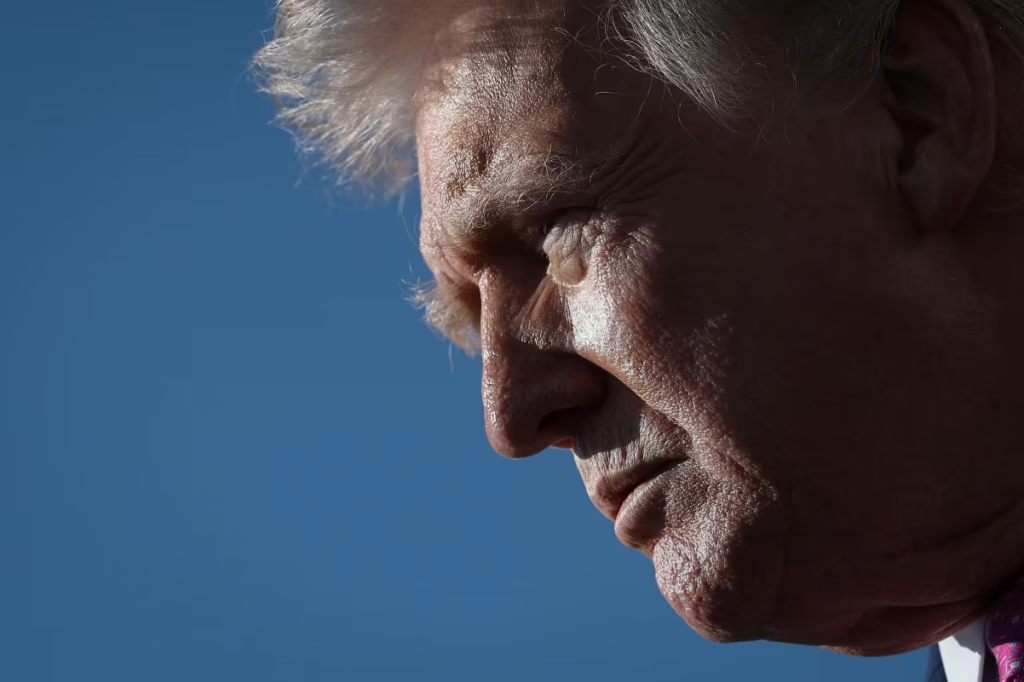
The iron laws of the world that govern Donald Trump’s presidency — strength, force and power — are increasingly being challenged at home and abroad.
Trump and his subordinates have made no secret of his belief in his own dominance and his willingness to wield untamed American might in pursuit of economic, geopolitical and domestic wins. His policies are an extension of a personal brand built on confrontation and the escalation of disputes.
But an increasingly chaotic international situation and growing domestic tumult suggest that the president’s methodology of escalation and coercion has limits — and that it may be leading him into damaging political corners.
The war in Iran is proving the ultimate test of Trump’s approach.
His instincts may help explain his decision to launch an assault on Iran’s military, nuclear and regional ambitions that previous presidents avoided. But Tehran’s refusal to surrender to Trump’s demands is beginning to reveal the limits of America’s power — and his own.
This has left the president with tough choices. He could escalate the conflict to try to compel Iran to comply with his demands, but that might increase US casualties and trigger intense economic blowback. He could claim a win and walk away — but Iran’s control of the Strait of Hormuz and retention of its enriched uranium stocks would belie any such claim.
To escape the trap, Trump has chosen a path that involves twinning American military power with his own refusal to cede ground to an enemy fighting back. His own new blockade of the strait is an attempt to throttle Iran’s economy despite the potential grave blowback on global energy markets.
The search for an endgame in Iran is the most important crisis for the president. But his erratic war leadership was previewed in other controversies.
He has failed to force NATO allies into joining a war they opposed and were not told about in advance. Even his threats to leave the alliance didn’t convince nations to abandon what they regard as their own national interests. Their lack of buy-in has cost the US options it often relied upon in past wars.
Trump’s brusque approach can work, such as when he cut some deals by using tariff warfare against US trading partners. But China, itself an economic superpower, hit back by threatening to cut off critical rare earths exports. Beijing used the potential of a trade war to melt down global markets and force Trump to back down.
Iran seems to have learned from that episode that the US is vulnerable to shocks in the global economy — and has done its best to hold it hostage with its own closure of the strait.
The sense that some of Trump’s powers are ebbing goes beyond the Iran impasse. He has seen the limits of his political magnetism after deploying his political movement to support Hungarian Prime Minister Viktor Orbán. But the effort failed Sunday as voters rejected the strongman and damaged Trump’s project to turn Europe MAGA.
As with his Hungarian counterpart, some of Trump’s domestic policies are causing a backlash. Public opinion forced him into a climbdown over his mass deportation program after the killings of two Americans by federal agents in Minnesota earlier this year. And the failure of most of Trump’s attempts to use the law to punish his political enemies — which helped trigger the firing of Attorney General Pam Bondi — shows that at least some constitutional guardrails are still penning him in.
Even Pope Leo XIV — an American who has angered the president with his vocal opposition to the war in Iran — was moved to say Monday, “I have no fear of the Trump administration.”
Why Trump believes his power is absolute
Trump has made no secret of his belief that he enjoys unchallenged power. “I (have) the right to do anything I want to do. I’m the president of the United States,” Trump said last August. He told The New York Times this year that the only curb on his actions abroad was “my own morality.”
That belief is reflected in his refusal to seek the input of Congress or to prepare the country for combat before launching a war that has now lasted six weeks.
White House officials, when asked about next courses of action in Iran, often reply with a variant of “only the President … knows what he will do” highlighting a trend of rejecting the power-sharing principles of the republican system.
The creed of might and escalation that underpins Trump’s second term was best expressed by deputy White House chief of staff Stephen Miller.
“We live in a world, in the real world … that is governed by strength, that is governed by force, that is governed by power,” Miller told CNN’s Jake Tapper in January amid White House euphoria over the capture of Venezuelan strongman Nicolás Maduro.
Trump’s dominance plays seemed to work better earlier in his presidential career. He turned the Republican Party into a vessel of his will that remains unwilling to constrain his wildest impulses despite tanking approval ratings.
The special forces raid that snatched Maduro from his home in January was a huge success for Trump. And under his “Donroe Doctrine” of Western Hemisphere dominance, he also used his political influence to help like-minded leaders win elections in Argentina and Honduras.
How Iran is undercutting Trump’s aura of omnipotence
But Trump’s luck may have started to run out in Iran.
The war started with a show of destruction familiar from other 21st century American conflicts, but it soon began to highlight the historical lesson that a massive air power advantage cannot on its own create unequivocal wins or regime change.
One way of looking at Trump’s strait blockade is as a bid to restore his own and America’s dominance over Iran to improve prospects for a negotiated solution. Choking Iran’s oil revenues and imports could send its economy into free fall. It might then have no choice but to sue for peace on Trump’s terms.
But one lesson of the war is that Iran’s leaders believe they are in an existential fight, and they’re prepared to inflict infinite suffering on their people. They may be betting Trump lacks the political tolerance for higher oil and gasoline prices and an inflation spike in a midterm election year. It could take months for the blockade to bring Iran to its knees. Time is a luxury that GOP congressional candidates lack.
A similar inability to dictate outcomes is unfolding in Europe.
The end of Orbán’s 16-year nationalist rule deprives the MAGA movement of a role model who effected crackdowns on immigration and the press, and who politicized big business and the law. His departure will deprive the administration of an ally inside the European Union, which Trump disdains. It’s a blow to Vice President JD Vance, who just traveled to Hungary to plead with voters to stick with Orbán.
And the spectacle of a massive turnout of voters rejecting populism and nationalism in an election defeat that is too big to deny may worry the White House.
But there are lessons for US Democrats too. Sunday’s result was hardly a victory of left-wing progressive values. The winning candidate, Péter Magyar, is himself a center-right leader who was once an Orbán loyalist. And unless he can beat the curse of European democratic leaders and fix struggling economies and health services, populism may remain a potent force.
In a broader sense, Orbán’s eclipse suggests that the cult of strongman leadership — at least in a quasi-democratic society — cannot indefinitely overcome powerful political currents and the curses of incumbency.
Trump’s belief that he enjoys untamed power was never founded in the Constitution or the American political tradition. And the inevitable decay inherent in second-term presidencies may weaken him further just as Iran is challenging his strongman’s aura externally.
But that leads to another difficult question: What might he do to prove his power is not ebbing away?