Fitness Experts Explain Why You Should Stop Counting the Seconds on Your Planks
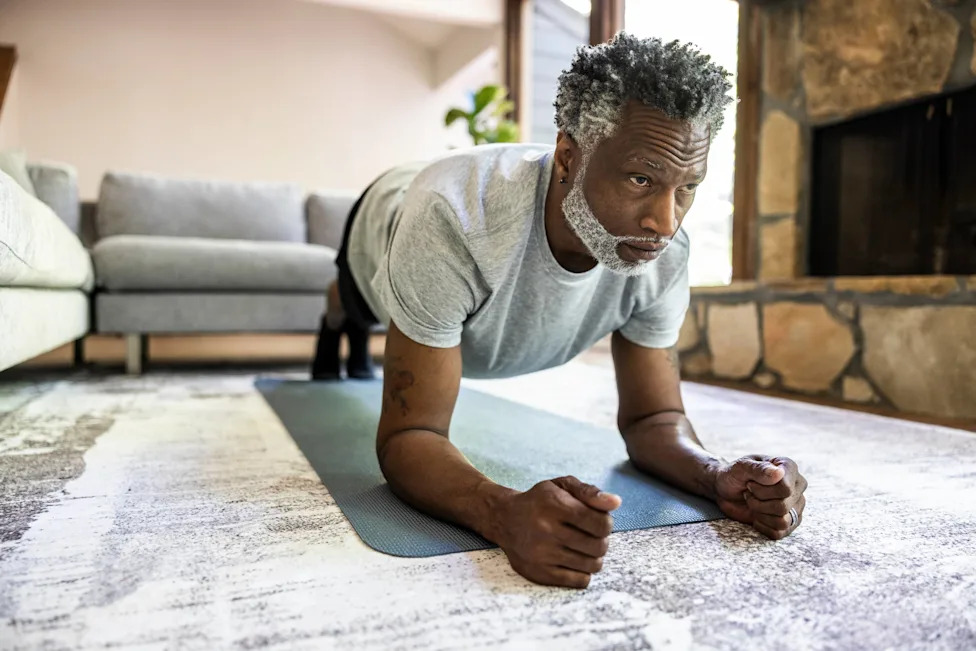
You finish a workout, drop onto your forearms, and start the timer. For many people, that is the entire ab routine.
Nearby, someone lies on their back, reaches one arm overhead, and extends the opposite leg. The movement looks less demanding, but their midsection is working to keep their back from arching.
That exercise is the dead bug. Like the plank, it trains your ability to keep your trunk stable. The difference is how it creates the challenge and that can help you decide where each belongs.
What Does a Dead Bug Do?
The dead bug starts on your back with your arms raised and your knees bent above your hips. You extend an arm and the opposite leg, then return and switch sides.
Your task is to move those limbs while keeping your torso steady.
In Harvard Health’s May 2026 guide, physical therapist Yasaman Zarbafian explains that the movement engages the abdominal muscles, including the deep transversus abdominis.
The floor also gives you useful feedback: if your lower back begins lifting as you reach, you can shorten the movement. The exercise can be adjusted further by keeping your feet planted and moving only your arms.
What Does a Plank Do Differently?
In a forearm plank, your forearms and toes support your body while your trunk and legs maintain alignment. Your hips should stay in line rather than sagging toward the floor or rising upward.
The American Council on Exercise emphasizes keeping the torso firm, the shoulders above the elbows, and breathing continuously.
The practical difference is straightforward: a basic plank asks you to maintain a position. A dead bug asks you to maintain control as your arms and legs change position.
Which Should You Choose?
Use the difference in setup to guide your choice:
- Choose dead bugs when you want to practice moving your limbs while keeping your trunk steady.
- Choose planks when you want to practice maintaining body alignment while supporting yourself above the floor.
- Include both if you enjoy them and can perform them comfortably. They provide different ways to practice core control.
A longer plank does not automatically mean you are getting more from the exercise. Likewise, reaching closer to the floor during a dead bug only helps if you can control that range.
How to Do a Dead Bug
This sequence follows Hospital for Special Surgery’s exercise guidance:
- Lie on your back with your knees bent and feet on the floor.
- Raise your legs until your knees are above your hips, bent about 90 degrees.
- Reach your arms toward the ceiling and engage your abdomen.
- Slowly extend your right leg and reach your left arm overhead, keeping your lower back against the floor.
- Return to the starting position, then switch sides.
Keep breathing throughout. Shorten your reach if your back starts to arch.
HSS’s routine uses 10 repetitions per side. You can begin with fewer while learning the movement. Zarbafian’s advice in Harvard Health is a useful standard: “You want your last rep to be as good as the first.”
How to Start With Planks
Place your elbows beneath your shoulders, extend your legs, and lift onto your forearms and toes. Keep your head aligned with your body and continue breathing.
Begin with a brief hold you can maintain comfortably. Cleveland Clinic’s core exercise guide suggests 20 to 30 seconds, but finish earlier if your hips sag, your position changes, or you feel pain.
For a simple introduction, practice one exercise during your next workout and the other during the following session. Notice which part challenges you: coordinating movement, maintaining alignment, or breathing while your muscles work.
You can build from there using our guide to core exercises beyond crunches.
This article provides general fitness information and is not a substitute for individualized medical advice. If you have an injury, persistent back pain, or a medical condition that affects exercise, consult a qualified healthcare professional before trying these movements. Breathe normally and stop if you experience pain or feel unwell.
This story was originally published by Men’s Fitness on Oct 11, 2026, where it first appeared in the Training section. Add Men’s Fitness as a Preferred Source by clicking here.