A cartel crackdown carries political risks for Trump
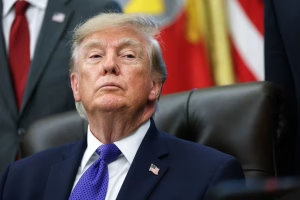
President Donald Trump had put Mexico on notice: Go after the country’s powerful drug lords, or he would.
His long-demanded crackdown arrived when the country’s most wanted narco-kingpin died after a shootout with the Mexican military.
But the unrest that erupted after the attempt to capture Nemesio “El Mencho” Oseguera Cervantes turned bloody carried a warning.
Trump’s zest for violent enforcement could sow turmoil far worse than the weekend’s gangland backlash that left Americans stranded in tourist hotspots and buses and businesses burning.
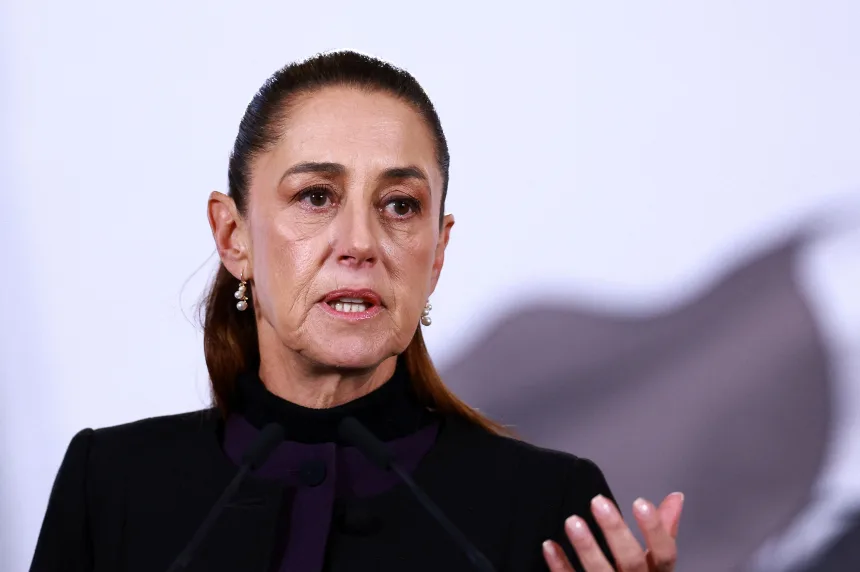
Mexican President Claudia Sheinbaum’s move against the leader of the hugely powerful Jalisco New Generation Cartel, which was aided by US intelligence, represented a hard policy turn following a year of intense pressure from Trump.
But the US president is already demanding more. He responded to the assault by writing on social media, “Mexico must step up their effort on Cartels and Drugs!”
El Mencho’s demise might ease a little US heat on Sheinbaum. But a more permanent cartel crackdown would create new dilemmas and political risks. Widespread, prolonged violence could turn voters against the president and hurt the economy or disrupt Mexico’s co-hosting of the FIFA World Cup this summer.
And history shows that high-profile killings or captures of drug lords might grab headlines and toughen political bragging rights on each side of the US-Mexico border. But they don’t stop drugs flowing to Americans or temper cartels, which seed corruption throughout Mexican business, law enforcement and politics.
Trump had warned Sheinbaum ‘isn’t running Mexico’
Washington often thinks everything is about itself. But viewing events in Mexico this weekend through a narrow prism of American politics ignores Sheinbaum’s initiative and personal political stakes. She came to power in 2024 vowing to end the more permissive cartel policies of her predecessors, and she had taken steps to rebuild the national security establishment and leadership before striking.
Still, her targeting of Jalisco — a cartel organization that is active throughout the country and has scores of affiliates — follows Trump’s refocusing of America’s power toward its restive backyard. The president has made no secret of his desire for a drug war in the context of a policy shift that now sees threats to the homeland and its orbit as among the worst national security problems. “We’re very friendly with her, she’s a good woman. But the cartels are running Mexico. She’s not running Mexico,” Trump told “Fox and Friends” on January 3.
A year ago, the State Department designated eight Latin American gangs and criminal cartels, including Jalisco, as foreign terrorist organizations. The Pentagon has since carried out a relentless operation to strike what officials describe as “drug boats” in the Caribbean and the Pacific. It has labeled the at least 151 people killed as “unlawful combatants,” but critics in Congress and human rights groups argue the strikes deny victims due process and infringe the Constitution and international law.
The administration resists such complaints. And the boat strikes, along with Trump’s wider posture toward the hemisphere, are becoming a way to test a new front of American First policy and to boost the president’s strongman aura.
The administration justified the daring US special forces raid that extracted Venezuelan dictator Nicolás Maduro in January as a blow to drug cartels. But it has since seemed most keen to exploit the country’s vast oil resources.
In another sign of intent, in its national security strategy, the administration wrote a “Trump Corollary” to the Monroe Doctrine to mandate hemispheric cooperation against narco-terrorists. The document also seeks to dispel the political and business influence in the region of foreign powers such as China.
Trump has long mythologized leaders who respond to the drug trade with extrajudicial violence. In his first term, he often lionized ex-Philippines president Rodrigo Duterte for a brutal drug war that killed thousands. Duterte is now in detention in The Hague facing International Criminal Court charges of crimes against humanity. Trump has also spoken of his envy at summary executions that he says China’s totalitarian President Xi Jinping uses to dispense with traffickers.
Still, Trump’s reaction following El Mencho’s death was more muted than most of his social media outbursts. This may be a sign Washington wants to shield Sheinbaum by not presenting her as a US proxy. White House press secretary Karoline Leavitt confirmed US intelligence support in a Sunday statement while offering praise and thanks to the Mexican military.
But across conservative media on Monday, the Jalisco crackdown was hailed as a Trump victory. Threatening violence against drug traffickers has always played well with the Republican base. And to be fair to Trump, he was one of the first national political candidates to appreciate the murderous toll of fentanyl in the US heartland. Oseguera was the subject of a $10 million US Drug Enforcement Agency bounty, partly for his role in funneling the drug to the United States.
Texas Republican Rep. Dan Crenshaw wrote on X that “this is the beginning of the war against the most violent and deranged cartel in Mexico.” Texas Sen. Ted Cruz said on his podcast Monday that he’d warned senior Mexican officials last year that if they didn’t get serious about drug cartels, Trump would.
“When I conveyed that message, I said, ‘Look, we’re not going to let you just sit there and turn a blind eye while these transnational criminal organizations flood position into America and kill Americans,’” Cruz said. “I will say, Mexico has pivoted sharply, and this is a real manifestation of that.”
Americans were left scared and stranded
Yet the optics of a narco-gangster’s violent end were matched Monday by frightening scenes from multiple Mexican cities. Hundreds of stranded Americans besieged the State Department with calls for help, including from the beach getaway of Puerto Vallarta. New York resident and model Natalie Belluccia, 28, told CNN it felt like “a war zone” in the resort. “I feel like the cartel is a little angry that the US is involved,” she said. “I think that we should have been warned (by the government) in some sort of way.”
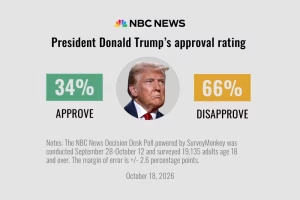
Sheinbaum pledged order would be restored. But as Trump contemplates a possible new US war with Iran despite the ebbing confidence of voters, he can ill afford a crisis that endangers Americans abroad.
And for all his tough talk, Trump will never control the Mexican drug wars. Experience suggests that Oseguera’s death could cause power vacuums and narco-turf wars, underscoring Sheinbaum’s gamble.
“I think it is certainly the riskiest of options that could have been on the table at that moment,” David Mora, senior analyst for Mexico at the International Crisis Group, told Isa Soares on CNN International. “What they did with El Mencho is going to bring instability not only within the Jalisco cartel structure, but with regards to the other smaller criminal groups that operate across Mexico.”
If violence worsens, Sheinbaum’s political standing and resolve could fray. Any impressions of US-engineered chaos could rebound against Trump.
And Oseguera’s death is just the beginning.
Crenshaw warned that a cartel power struggle was breaking out and said that roadblocks, intimidation and targeted attacks should be expected in Mexico. “Either way, this is what a criminal terrorist organization under pressure looks like. And we will see if Mexican leadership and the Mexican people cave to it or finally decide to fight it,” Crenshaw wrote on X on Monday.