The role of artificial intelligence in the digital transformation of government
The artificial intelligence (AI) domain which has advanced significantly in recent years is transforming the world; as a result, some countries have developed a specialized policy in an attempt to gain an edge in a technological race. These policies outline specific issues of interest, formulate plans for mobilization, and designate areas of governance which geopolitically manage the domination and mastery of AI technologies and control over them.Opportunities of AI-enabled government transformation.
Research indicates that the transformation empowered by artificial intelligence will bring about four major opportunities: strengthening the decision-making foundation and administrative execution efficiency; Improve the response speed and accuracy of public services; Enhance transparency and promote public participation; Upgrade cross-departmental collaboration through data sharing.
1 Enhancing decision-making scientific basis and administrative efficiency
Utilizing AI within various arms of the government presents unparalleled possibilities for augmenting the scientific basis of decision-making as well as the administrative efficiency of government bodies. Current AI technologies surpass anything previously achieved in their ability to process sophisticated data, detect relationships within data, and even form conclusions, which has the potential to shift systematized methods of governance.
Table 2 shows a comparison between traditional and AI-enhanced methods in five distinct areas of government decision making. The information provided in the table indicates that there have been improvements in the efficiency of processes and the quality of the results when AI technologies are used appropriately in public administration.
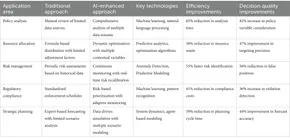
The AI-aided policymaking rationale gets stronger on the empirical side with the ability of an AI to make concurrent purposive synthesis from multiple information sources. In policy analysis, AI systems can extract data from both structured and unstructured sources simultaneously which reveals relationships that, in standard analyzes, are very likely to go unnoticed. This advanced analysis permits the examination of policy constituents, context, and outcomes in a holistic manner.
AI assists in the optimisation of processes and also improves effectiveness in the refinement of administration. Resource allocation models based on static formulations are obsolete as dynamic algorithmic optimisation is now possible which continuously recalibrates allocation to ever-changing demands and performance benchmarks. Oversight compliance systems also benefit greatly from regulated resources governed by complex risk profiles instead of predetermined schedules under risk-based approaches.
With the advent of Artificial Intelligence, strategic planning can involve simulations that provide frameworks of complex histories made up of multiple interacting parts. AI also allows adaptive and contingency plans to be developed in contrast to forecasting which relies on expert intuition.
While these applications are promising, artificial intelligence decision-augmentation applications require careful attention to framed policies around data-digital security, algorithmic transparency, and the right balance of human participation. Effective systems tend to rely on practical norms and perimeter-based judgments regarding data collection, pattern recognition, capability development, and other achievable tasks; the decisions tend to be AI-based. This blend of humans and AI allows for ethical concerns of human decision-making to be fused with AI’s ability to use data to optimize processes and accelerate outcomes which, in countless novel ways, are grounded in scientifically proven frameworks.
2 Optimizing public service quality and precision
Integrating artificial intelligence into the public services offered by the government is an opportunity that can fundamentally change the method of delivery and improve the quality of services and the accuracy of government functions. By leveraging advanced data analytics, personalization algorithms, and predictive capabilities, AI technologies enable more responsive, customized, and efficient public services that better address diverse citizen needs.
Table 3 presents a comparative analysis of traditional versus AI-enhanced service models across five essential public service domains. The data demonstrates significant improvements in both service quality metrics and precision targeting when AI technologies are appropriately deployed in public service contexts.

The quality improvement has achieved remarkable results in terms of citizen satisfaction, medical outcomes and the efficiency of services at all levels. The integrated medical system through the application of artificial intelligence data, with highly personalized diagnosis and treatment processes and proactive health management plans, significantly enhances patient satisfaction. For instance, the Danish National Health Service uses AI to analyze patients’ genetic data and medical history to formulate personalized treatment plans for cancer patients. As a result, patient satisfaction has risen from 60 to 82%. Similarly, integrated teaching projects that adopt artificial intelligence technology achieve a comprehensive improvement in teaching effectiveness by continuously optimizing personalized teaching resources, while also realizing precise matching and optimized upgrading of teaching content. For instance, in Finland, an intelligent education platform pushes customized courses based on students’ learning data. As a result, the pass rate of students in a certain region has risen from 70 to 97%.
Among social welfare service projects, the improvement in accuracy brought about by artificial intelligence technology is the most significant. By intelligently assessing demands and optimizing resource allocation, the problems of excessive or insufficient services that might occur in the traditional model have been replaced by a precise demand assessment system. This system can more precisely match service supply with individual demands, not only enhancing service efficiency but also optimizing cross-domain resource allocation. For instance, the social welfare department in Sweden has utilized AI to analyze the family structure, health conditions, and employment situations of applicants, and has formulated personalized welfare plans. As a result, the success rate of employment assistance programs has increased from 50 to 72%, and the rate of duplicate welfare distribution has dropped from 15 to 7%.
In the transportation sector, intelligent technologies have enhanced productivity. Demand-based automatic scheduling and dynamic routing further optimize service efficiency and availability. For instance, the public transportation system in Berlin, Germany, utilizes AI to analyze passenger flow data and road conditions in real time, dynamically adjusting bus routes and departure frequencies. As a result, the average travel time for a certain bus route has been reduced from 60 min to 41 min, and the punctuality rate has increased from 65 to 101%. In administrative services, productivity growth is most significant, thanks to the complex error-checking systems provided by virtual assistants and automated processing systems, which have improved processing time and accuracy. For instance, the AI passport application review system launched by the Australian Department of Home Affairs has shortened the review time from 7 days to 3 days and reduced the error rate of form filling from 20 to 11% through an automatic form review algorithm and intelligent customer service.
The application of artificial intelligence technology in service models has sparked important discussions on fairness, social equity and the efficiency of humanized services. Even in the face of complex social interaction scenarios, automated systems should at least achieve the following: when AI handles repetitive tasks, it should withdraw from intervention and instead provide proactive and personalized assistance around the clock. Only by meeting this condition can public services designed around specific individual needs achieve the best performance and ensure that the system operation reaches the optimal state. For instance, the AI system for older adults services in Netherlands automates repetitive tasks such as daily care appointments, while providing 24 h intelligent voice assistants for the older adults to answer health inquiries. This not only enhances service efficiency but also ensures humanized interaction.
3 Enhancing government transparency and public participation
The continuous growth of artificial intelligence (AI) technologies may provide new opportunities to improve government transparency, increase public participation, and effectively respond to informational accessibility concerns in relation to civic engagement. In regard to civic engagement, this has been an ongoing dilemma for some time now. Contemporary AI tools are providing higher-level access and mechanisms of information access which enable citizens to actively participate in public administration and policymaking processes.
Access to AI technologies that improve clarity and heighten civic participation at all levels of government enable citizens to engage and actively collaborate in the processes of policy formulation and decision making. Complex relationships within various domains of governance are presented visually and spatially as appealing dynamic images depicting critical policy decisions, budgetary expenditures, even administrative efficiencies as easy-to-grasp animated images citizens can readily access. Moreover, technical documents can be eloquently simplified by language processing tools, thus removing barriers in the information flow between the government and its citizens. Automated report generation functions provide powerful tools to effortlessly achieve real-time transparency in government information disclosures, thus enhancing the timeliness, accuracy, and completeness of information updates beyond scheduled manual updates.
The emergence of artificial intelligence technology has increased the value and effectiveness of interaction in a participatory sense. AI, for instance, effectively controls public discussion forums or what is known as digital deliberation, overcoming the limitations of face-to-face gatherings (on the order of thousands or millions of people). Through the use of AI tools, sentiment analysis and opinion mining, government organizations are able to gather and analyze public sentiment and perception about issues on a scale never before possible. Citizens’ attitudes that would normally be unearthed only by consultation methods that are hidden with conventional methods provide insights into attitudes concealed by traditional means. Tailored forms of participation allow for citizens to be matched with opportunities that align with their professional background and personal interests, thus enhancing both the reach and depth of participation.
Case providing implementations offer an Amsterdam example of administering these methods in practice. The “Open Algorithms” project allows citizens to access algorithmically executed local government decision-making processes with interpretive feedback interfaces. In South Korea, AI technologies are integrated into the “National Participation Platform” that scans countless proposals by citizen interest. AI determines consensus points and enables collaborative policy construction through formalized deliberation. In Finland, the “AI Assistant for Public Consultation” facilitates active retrieval of feedback on political documents making it possible for citizens to contribute textually, with the assistance during the consultations serving to increase input volume as well as participant engagement.
Taking the controversy over the “Transparent Budget AI Platform” in Mexico as an example, it reveals the risk of “digital exclusion” behind technological transparency—although the platform realizes the visualization of budget data, its interface only supports Spanish and requires at least 8Mbps of network bandwidth, resulting in 42% of grassroots people being unable to use it effectively. Based on this, this study proposes a “three-dimensional transparent evaluation system”: (1) Accessibility (language compatibility, device compatibility, network threshold); (2) Readability (information granularity, visualization complexity, proportion of professional terms); and (3) Interactivity (feedback response speed, opinion collection rate, diversity of participation channels). Taking Norway’s “Climate Policy AI Consultation System” as a positive case, this system has increased the public participation rate to 68% through “multilingual support + offline access function + voice interaction interface,” which is 257.9% higher than the traditional online questionnaire. At the same time, it has established a “suggestion adoption tracking mechanism,” publicly displaying the processing progress of each public suggestion, with an adoption rate of 31%. Significantly enhance public trust.
The unwarranted application of such recent frontier technologies undoubtedly holds risks. Implementing AI as a tool for encouraging participation and ensuring policy transparency requires careful deliberation. Designers of technological transparency should not succumb to too much reliance on algorithms that their workings, often characterized as black-box systems, hinder transparency themselves. Gaps concerning the accessibility of technology as well as requisite skills must be eliminated in order to provide for equitable participation across demographic divides. Technology’s role should be that of a facilitator of democratic discussions rather than a substitute. As such, equilibrium between authentic human involvement and AI must be determined.
Incorporating artificial intelligence in terms of engagement and transparency can improve the circulation of information, expand the range of engagement, and make policies, within a democratic scope, more attentive to citizens’ needs.
4 Promoting data sharing and departmental collaboration
The adoption of Artificial Intelligence technologies offers a unique set of advantages, particularly concerning ease of collaboration both within and between government agencies. Moreover, these technologies can aid in restructuring bureaucratic systems into more agile and integrative frameworks of governance. The AI technologies in use guarantee meaningful information exchange and cross-organizational collaboration in the resolution of complex, multi-dimensional problems which transcend defined organizational boundaries in an efficient and secure manner.
Enhanced information sharing stems from a number of technological options. Sophisticated data integration technologies have the capability of merging disparate sets of data residing in different organizational silos into singular cohesive data products without standardization processes. Model crafting collaboration permits the withholding of sensitive information fragments while mitigating privacy as well as security risks during data sharing. Enhanced privacy preserving data sharing increases the ease of sharing sensitive information among participants. Proactive intelligent information retrieval systems are capable of identifying and retrieving associated information from various departmental silos, resulting in reduced costs for access and retrieval.
Through the use of artificial intelligence, its benefits also extend to fostering inter-departmental cooperation through supporting joint actions and collaborative analysis. Multi-departmental consortia, even with gaps in their diverse disciplines and institutional frameworks, are able to form a common understanding of complicated problems through the use of AI Multi-Interpretative systems for Integrated Diagnostics and Reporting – an example of AI-assisted analytics systems. Complex, inter-organizational proprietary workflows can be managed by Coordination intelligent systems employing sophisticated job allocation techniques, ensuring proper order, as well as responsibility attribution despite the absence of centralized control mechanisms. Anticipatory multidisciplinary collaborative problem modeling strengthens the ability to pre-emptively deal with emerging problems before they materialize, instead of adapting plans after the fact reactive coordination executed post-problem emergence.
The exact matching of technical proficiency successfully addresses the inherent difficulties that have traditionally hindered coordination among governmental agencies. Gaining practical judgment accompanied by familiarity with important data sources lessens the information asymmetry within a given organizational structure. Completing collaborative work is greatly automated by processes like careful AI-powered discovery, aggregation, and coordination, which also lower the working costs. Data sharing barriers to inter-organizational collaboration and cultural silos entrenched within the organization could also be resolved by AI data sharing, quipped “operation enhancements”, of course with critical safety and privacy measures “cut in” as though glued.
Specific scope of challenges regarding implementation can be resolved by the adoption of appropriate governance frameworks. Legal governance policies must allow encrypted data sharing that’s responsible without gaps for careless blunders. Inter-division conflicts regarding the quality of information require governance procedures through managed validation and confidence processes. Organizational norms also require realignment bolstering proactive support aimed at collaboration instead of information control. Strategic investment toward agile infrastructure techniques also provides implementation for secure exchange standards of the system.
These expected advantages will be realized, which will further augment enhanced governance. Engagement adds coherence in policies as cross-system and interdepartmental fusion problems are dealt with more efficiently. Services are better integrated and become more responsive in relation to the demand from citizens, thus transcending administrative boundaries. There is broader use of composite information and collective reasoning for the analysis of social complexities from climate responsiveness to social vulnerability. If optimally leveraged, the information exchange enabled by AI technology, alongside interdepartmental collaboration, has immense transformational capacity to replace governance in departmental silos with integrated cross-departmental problem solving.